
My brother raised his beer at our Fourth of July cookout and announced, "Ask Nora how many hospital beds she made this week. She loves pretending she practices medicine."
My mother laughed first.
Then nearly everyone else on the deck joined her.
They thought they had embarrassed me in front of half the neighborhood.
Twenty minutes later, my nine-year-old nephew Mason was pulled from the lake unconscious, blue around the lips, and not breathing.
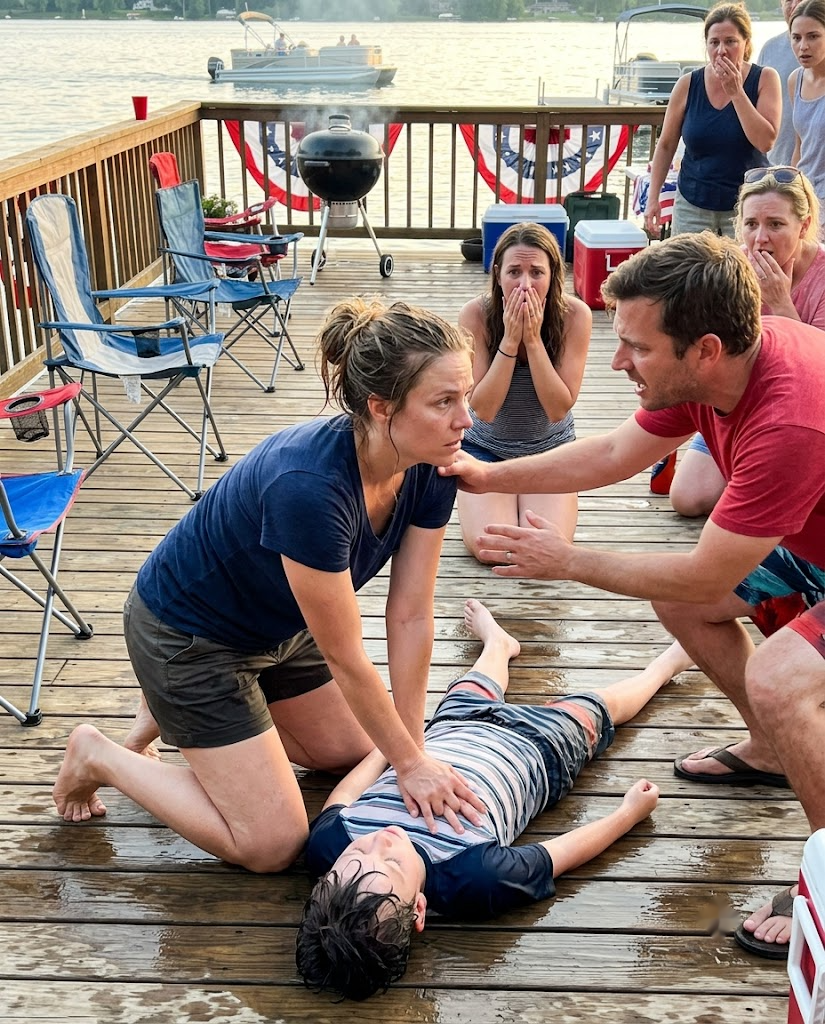
While my brother Blake screamed that I was doing everything wrong, I dropped beside his son and started the resuscitation he had just spent ten minutes insisting I wasn't qualified to understand.
And when we reached the hospital, the medical director looked at me beside Mason's stretcher and said six words that erased Blake's smile.
"Why is my ER chief outside?"
For most of my adult life, my family had described my career as whatever version sounded least impressive.
My mother, Judith, told relatives I "helped out at a hospital."
Blake preferred calling me a medical assistant, transporter, receptionist, or, whenever he had an audience, the woman who changed sheets after the real doctors went home.
It hadn't started as cruelty, at least not openly.
When I entered medical school, Blake joked that I would probably faint the first time I saw blood. When I began residency, he told relatives I was "still in training" as though that meant I was pretending.
Years passed.
The jokes never evolved because his opinion of me never evolved.
When I became an attending physician, he told our mother I had "finally gotten a hospital job."
When I was appointed deputy chief of emergency medicine, he introduced me at Christmas as "Nora, who basically works triage."
When Capitol Lakes Medical Center named me chief of the department, I didn't tell him.
By then, correcting Blake felt like volunteering for an argument with someone whose favorite fact was whichever one protected his ego.
The irony was that he wasn't unintelligent.
Blake owned a successful landscaping company. He could calculate payroll in his head, negotiate contracts, and remember the cost of every machine he had purchased in ten years.
He simply needed to be the most impressive person in any room containing family.
I was his younger sister.
In his mind, that meant I was supposed to remain behind him forever.
Our mother helped maintain the arrangement.
Judith praised Blake's business constantly. She told strangers how many employees he had and how many properties his company serviced.
When people asked about me, she said, "Nora works at the hospital."
That was usually all.
The Fourth of July gathering took place at Blake and Tessa's lake house outside Madison, Wisconsin.
Their backyard sloped toward the water. A wooden dock stretched beyond a narrow swimming area marked with floating rope. Red, white, and blue bunting hung from the deck railings, and a portable speaker played country music loud enough to compete with the boats crossing the lake.
About thirty people were there by midafternoon.
Neighbors, cousins, friends from Blake's company, Tessa's sister, several children, and my mother occupied nearly every chair.
I arrived carrying a bowl of pasta salad and a watermelon.
Mason usually met me before I reached the steps.
He was the sort of child who ran instead of walked when he saw someone he loved.
That day, he didn't.
I found him sitting alone on the lower patio step, elbows on his knees, rubbing his eyes.
"Hey, troublemaker," I said. "You hiding from everybody?"
He gave me a sleepy smile.
"No. Just tired."
Something about him bothered me immediately.
His voice was slower than usual. When he stood, he swayed enough to catch himself against the railing.
I crouched beside him.
"Did you stay up all night?"
"Dad said I'd be fine."
That answer made me look toward Blake.
He was standing at the grill with a beer in one hand and metal tongs in the other.
"Blake," I called. "Can I talk to you?"
He glanced over.
"What's wrong now?"
I lowered my voice when he came closer.
"Mason seems unusually drowsy. He's a little unsteady too. I'd keep him out of the lake until he's acting normally."
Blake smiled as if I had handed him a perfect setup.
"Here we go."
"I'm serious."
He raised his voice deliberately.
"Everybody, Nora has diagnosed Mason with being tired. Good thing we have hospital support staff here."
Several people laughed.
My mother shook her head affectionately at him.
"Nora, please don't turn the cookout into work."
Mason looked embarrassed.
That bothered me more than Blake's joke.
I put one hand lightly on my nephew's shoulder.
"I'm not diagnosing anything. I'm saying he looks too sleepy to swim right now."
Blake took a drink of beer.
"He's nine years old. He stayed up late watching fireworks videos. That's the whole medical mystery solved."
Tessa was carrying hamburger buns from the kitchen when she heard us.
She paused.
"He was complaining earlier that his head felt weird," she said.
Blake's face tightened.
"He's fine, Tess."
Then he turned away.
I considered pushing harder.
But Mason wasn't alone. Two dozen adults surrounded him, including both parents. He was awake and talking. I had no authority to seize control of someone else's family gathering because I disliked how tired a child looked.
So I stayed nearby.
Blake eventually returned to the grill and started entertaining his friends again.
That was when my career became the joke of the afternoon.
Someone asked whether I had the holiday off.
Before I could answer, Blake raised his beer.
"Ask Nora how many hospital beds she made this week. She loves pretending she practices medicine."
Laughter spread around the deck.
My mother joined in.
"She was always very dramatic about work," Judith said.
Blake pointed toward me.
"She tells people she handles emergencies. I think she means when someone needs clean sheets fast."
More laughter.
I looked at Tessa.
She wasn't laughing.
Neither was Mason.
I set the watermelon bowl on the table.
"Finished?"
Blake grinned.
"Don't be sensitive."
"I'm not."
That seemed to disappoint him.
He wanted anger. He wanted a speech he could mock.
Instead, I picked up a stack of paper plates and carried them outside.
A few minutes later, I noticed Mason's chair was empty.
At first I assumed he had gone inside.
Then I saw his sandals beside the dock.
I looked toward the swimming area.
Three children were splashing close to shore.
Mason wasn't with them.
My eyes moved beyond the rope.
Something pale broke the surface near the end of the dock.
An arm.
Still.
My body reacted before my mind finished understanding.
"Mason!"
I ran.
Someone behind me shouted my name.
I kicked off one sandal, lost the other somewhere on the boards, and dove fully clothed into the lake.
The cold shocked the breath out of me.
I surfaced, swam toward him, caught the back of his swim shirt, and turned his face upward.
He didn't respond.
By then Blake was running down the dock.
"What happened?"
"Help me get him up."
Together we lifted Mason onto the boards.
Tessa screamed when she saw him.
His face had the frightening stillness every emergency physician knows too well.
I checked him and started resuscitation.
Blake hovered over me for only seconds before panic transformed into interference.
He grabbed my shoulder.
"You're hurting him!"
I kept working.
"Take your hand off me."
"You're pressing too hard!"
"Blake, move."
"You're going to break something!"
I looked up once.
"Move. Now."
He let go.
There are moments when years of training narrow the world.
The screaming disappears. The spectators disappear. The personal relationship disappears.
There is only the person in front of you and the next necessary action.
Mason was not my nephew in that moment.
He was a child without effective breathing, and I did what I had been trained to do.
Someone called 911.
Tessa knelt nearby sobbing his name.
Judith stood at the end of the dock with both hands over her mouth.
The same people who had laughed at me minutes earlier were suddenly silent.
Then Mason coughed.
It was weak, but it was real.
He drew in a ragged breath.
Tessa made a sound I will never forget, somewhere between a sob and a gasp.
I kept him positioned safely and stayed with him until paramedics arrived.
One of them knelt beside me.
"Who started resuscitation?"
"I did."
He looked at the way I was positioned, then at me.
"Medical?"
Before I answered, Blake said, "She's my sister. She works at a hospital."
The paramedic gave him a puzzled glance.
"What kind of work?"
"Emergency medicine," I said.
Blake said nothing.
As the crew prepared to leave, I remembered Mason's condition before he entered the lake.
I pointed toward the patio.
"Bring his swim bag and the cup he was drinking from. Anything that belongs to him."
Blake frowned.
"Why would they need that?"
"Because he was unusually drowsy before this happened."
I watched his face.
For half a second, something passed through it that wasn't confusion.
Fear.
Then it vanished.
"He was tired," he said.
"Maybe."
The ambulance took Mason to Capitol Lakes Medical Center.
I rode separately with Tessa because there wasn't room for all of us.
By the time we entered the emergency department, the pediatric team had already been notified.
Blake rushed toward the doors behind the stretcher.
I moved with them.
He stepped in front of me.
"Stay here."
I stared at him.
"Excuse me?"
"You've done enough. Let actual doctors take over."
A nurse standing at the entrance looked at him, then at me.
Her expression was almost comical.
I could have corrected Blake immediately.
Instead, I stepped aside because Mason mattered more than my brother's ignorance.
Then Dr. Simone Alvarez rounded the corner.
Simone had been medical director for six years and had recruited me personally to run the emergency department.
She took two steps, saw me soaked from head to toe, and stopped.
"Why is my ER chief outside?"
Blake's face changed.
My mother blinked.
"Your what?"
Simone turned toward them.
"Dr. Keene is chief of emergency medicine."
Nobody spoke.
Blake looked at me as though I had somehow tricked him.
"You're a doctor?"
I almost laughed.
Not because anything was funny.
Because after years of mocking my work, that was the question he chose.
"Yes, Blake."
"Why didn't you tell us?"
"I did. Many times. You preferred your version."
The nurse opened the doors for me.
I didn't enter as Mason's treating physician. That would have been inappropriate with such a close family relationship.
Instead, I remained his aunt while another team cared for him.
But I understood every update they gave us.
His breathing stabilized.
His oxygen level improved.
The first neurological signs were encouraging.
Tessa cried against my shoulder when we heard that.
Blake sat across the room staring at the floor.
About forty minutes later, Simone returned.
This time Dr. Henry Park, one of our toxicologists, was beside her.
That immediately caught my attention.
Henry rarely appeared in person unless a laboratory result required interpretation.
Simone carried Mason's preliminary chart.
She turned one page toward me.
"Nora, the lab found something in Mason's blood that shouldn't be there."
Blake's hand closed around the back of a chair.
Henry looked directly at him.
"Mr. Keene, what exactly did you give your son before he went swimming?"
Blake stood too quickly.
"Nothing."
Henry didn't raise his voice.
"His toxicology screen detected diazepam. We confirmed the result."
Tessa stared at her husband.
"Diazepam?"
I knew Blake had once mentioned taking prescription medication for severe anxiety after a business accident two years earlier.
I looked at him.
"Is that yours?"
"This is ridiculous," he said. "He must've gotten into something."
Henry remained calm.
"Was Mason prescribed it?"
"No."
"Then we need to determine how it entered his system."
Blake pointed at the chart.
"Run the test again."
"We already confirmed it."
The door opened.
A nurse entered carrying a clear property bag containing the items paramedics had collected from the lake house.
Mason's goggles.
His red swim shirt.
The plastic cup.
And an orange prescription bottle.
The label showed Blake's name.
He moved toward it immediately.
"That's mine."
Nobody responded.
He continued talking, faster now.
"He must have gone through my bag. Kids do stupid things. He probably thought they were candy or something."
Tessa stopped crying.
Slowly, she lifted her head.
"No."
Blake turned.
"What?"
"He didn't take it himself."
The room changed.
I watched Tessa reach into her purse and pull out her phone.
Her hands shook so hard she nearly dropped it.
"Earlier, at the picnic table," she said, "you said something that scared me."
Blake went pale.
"Tessa, don't."
That was the moment I knew.
Not suspected.
Knew.
Tessa looked at Henry.
"Can I play a recording?"
Henry glanced at Simone, who quietly closed the door and asked a nurse to notify hospital security.
Tessa opened an audio file.
The recording began with music and outdoor conversation.
Then Blake's voice came through clearly.
"He wouldn't stop complaining about the fireworks tonight, so I gave him half of one of mine. He'll calm down."
Tessa's recorded voice answered immediately.
"You gave Mason your anxiety medication? Blake, are you insane?"
His response came through the speaker.
"Relax. It's half a pill. He'll sleep it off."
Then came a sound that made my stomach turn.
Blake laughing.
Tessa stopped the recording.
Nobody said anything for several seconds.
My brother looked at me.
"I didn't know he'd go swimming."
Tessa stared at him.
"You watched him walk toward the dock."
"I thought he was fine."
"Nora told you he wasn't fine."
His eyes moved toward me.
For the first time all day, he had nothing sarcastic to say.
He whispered, "I was only trying to calm him down."
I felt anger then.
Real anger.
Not because he had mocked me.
That suddenly seemed insignificant.
I was angry because he had noticed his son's discomfort, responded with his own prescription medication, dismissed warning signs, and then allowed the boy near open water.
Worst of all, when Mason nearly died, Blake's first instinct had been to interfere with the person trying to save him because admitting I knew what I was doing would have wounded his pride.
Hospital security arrived.
Because a child had suffered a life-threatening event involving medication not prescribed to him, the hospital's safeguarding procedures were activated and law enforcement was notified.
Blake panicked when he realized the police were coming.
He looked at Tessa.
"Tell them it was an accident."
She recoiled.
"It was your decision."
"Tessa, I'm his father."
"Then you should have protected him."
He turned to me next.
"Nora, please. You know I didn't mean for this to happen."
I looked at my brother, wet shoes still squishing slightly against the hospital floor.
"Intent doesn't erase what happened."
My mother finally found her voice.
"This family doesn't need police involved. Mason is alive. Can't we handle this privately?"
I stared at her.
That sentence hurt more than the jokes had.
"Mom, Mason nearly died."
"But Blake made a mistake."
Tessa stood.
"A mistake was forgetting sunscreen. He gave our son prescription medication and sent him toward a lake."
Judith looked at me as though I could fix the room by agreeing with her.
I couldn't.
Two officers arrived later and spoke separately with Blake, Tessa, Henry, and members of the medical team.
Tessa gave them the original recording from her phone.
The prescription bottle was documented with Mason's belongings.
The toxicology result became part of his medical record.
I gave a statement about Mason's behavior before the incident and about warning Blake that he appeared unusually drowsy.
I didn't exaggerate anything.
I didn't need to.
The facts were enough.
Blake was not taken away in handcuffs that night.
Real life was less theatrical than that.
The officers completed their initial interviews and explained that investigators would review the evidence.
Tessa told Blake he would not be going home with her.
He looked stunned.
"You're throwing me out?"
"I'm protecting Mason."
That sentence seemed to reach him in a way nothing else had.
He sat down and covered his face.
Sometime after midnight, Mason opened his eyes fully.
Tessa and I were beside him.
He looked confused at first.
Then he saw me.
"Aunt Nora?"
I smiled despite the exhaustion pressing behind my eyes.
"I'm here."
He swallowed.
"Did I miss fireworks?"
Tessa burst into tears and kissed his forehead.
I laughed softly.
"Yeah, buddy. You missed the fireworks."
His recovery took time, observation, and follow-up, but he eventually went home without the devastating neurological injury we had feared during those first minutes on the dock.
The legal aftermath lasted much longer.
The investigation confirmed the medication belonged to Blake. Tessa's recording supported her account of how Mason had received it, and multiple guests remembered me warning Blake that Mason seemed too impaired to swim.
Months later, Blake pleaded guilty to a child-endangerment charge as part of the case against him.
The court required supervision restrictions, counseling, and other conditions before he could resume unsupervised parenting time.
Tessa filed for separation.
My mother blamed me for several weeks.
She said I should have protected my brother because family was supposed to protect family.
I finally asked her one question.
"Who was protecting Mason?"
She didn't answer.
For the first time in my life, I stopped arranging my choices around whether Judith or Blake approved of me.
I didn't cut my mother off completely, but I stopped accepting contempt disguised as humor.
When she made one joke about my "hospital job" several months later, I stood, picked up my coat, and left dinner.
She never made another one in front of me.
Blake eventually wrote me a letter.
It contained no jokes.
He admitted that he had spent years minimizing my career because my achievements made him feel small.
He also admitted that on the dock, when he grabbed my shoulder, some part of him had still been more concerned with proving I wasn't an expert than with accepting that his son needed one.
I read the letter once.
Then I put it in a drawer.
Forgiveness, I learned, was not the same as pretending consequences had never happened.
The only relationship I cared about rebuilding quickly was my relationship with Mason.
That autumn he came to the hospital with Tessa for a follow-up appointment.
Before they left, he handed me a folded piece of construction paper.
Inside, he had drawn the lake, the dock, and two stick figures.
One was lying down.
The other had enormous arms and wild black hair.
"Is that supposed to be me?" I asked.
He grinned.
"You needed big arms because you saved me."
I had spent years performing emergency procedures people would never know about.
I had treated strangers on the worst days of their lives and gone home without anyone applauding.
I didn't need my family to understand my title.
I didn't need Blake to respect my training.
But I kept Mason's drawing.
It hangs inside my office now, behind the door where patients and visitors rarely notice it.
Not because it proves I was a doctor.
A diploma already does that.
I keep it because that afternoon taught me something more important than winning an argument.
Being underestimated had never made me less capable.
And Blake finally learned that mocking expertise does not make it disappear.
Sometimes the person you spend years trying to make small becomes the person you desperately need when everything goes wrong.
